


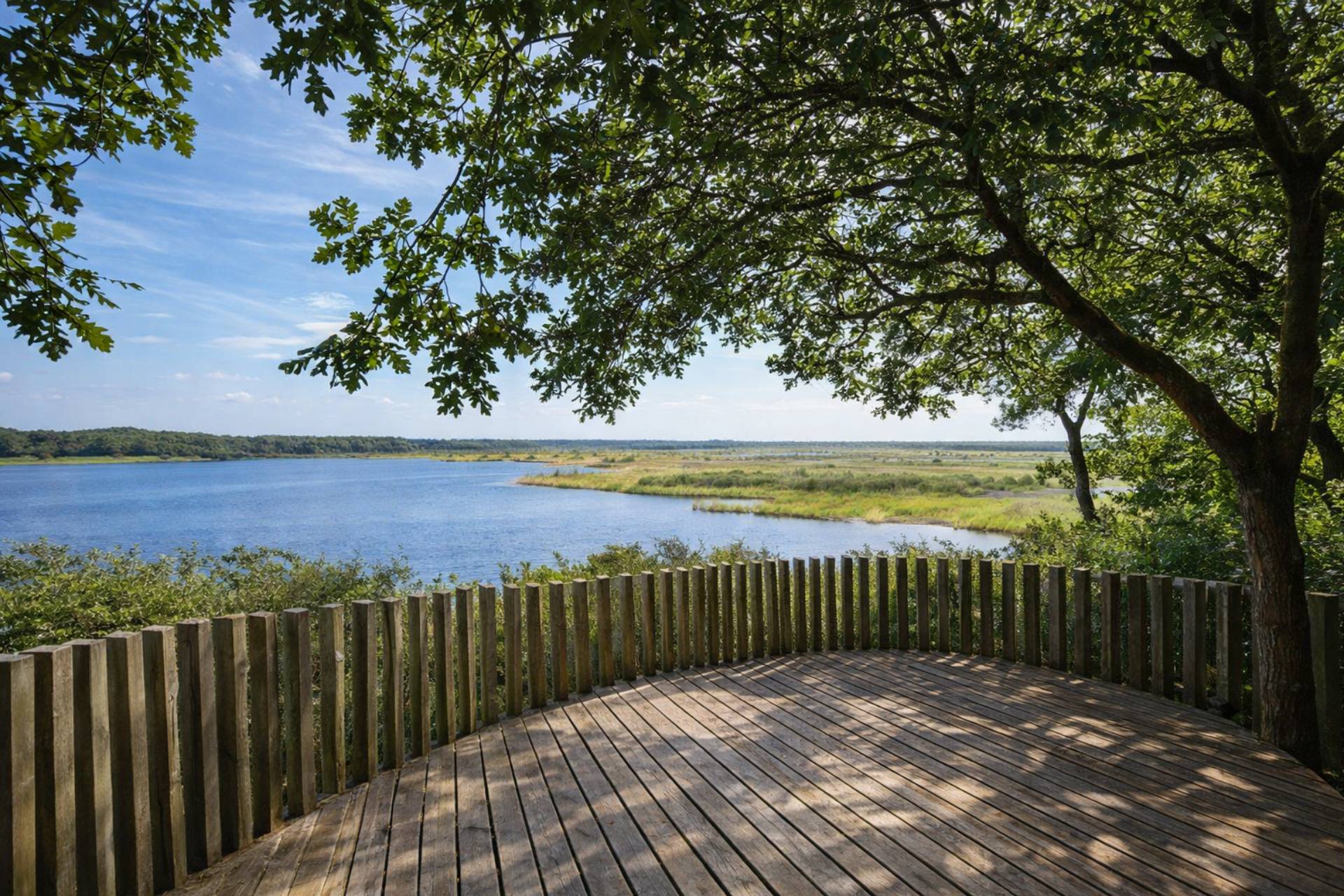
The Etang de Cousseau nature reserve lies between the lakes of Carcans-Hourtin and Lacanau, in Gironde. This 600-hectare protected site is home to over 3,000 species in the heart of the Médoc. Classified since 1976, it is accessible only on foot or by bicycle. Here’s everything you need to know to prepare for your visit: cranes, European pond terrapins, signposted trails.
If you’re staying at our Campsite in Gironde, this nature outing, just 25 kilometers away, is a must.
Key points to remember
- The Etang de Cousseau national nature reserve covers 600 hectares in the commune of Lacanau, Gironde.
- More than 3,000 plant and animal species have been recorded here.
- The site is made up of 3 distinct habitats: a dune, a marsh and a forest.
- A signposted 7 km round-trip route allows you to discover the reserve on foot or by bike.
- Access is free all year round, and guided tours can be booked in advance.
A protected area between lakes and ocean
The Etang de Cousseau nature reserve covers 600 hectares, 50 km from Bordeaux. Created in 1976, it is one of the oldest protected natural sites in the region. A state-supervised management plan guides SEPANSO‘s actions. SEPANSO oversees the protection and development of nature in the South-West of France.
The site takes its name from a small body of freshwater located between the 2 large Médoc lakes. It features 3 very different natural environments. The wooded dunes of the dune belt run along the Atlantic coastline. The marshes and wetlands surround theEtang de Cousseau. Finally, the pedunculate oak and maritime pine forests complete the landscape. This mosaic of landscapes, in the continuity of the Landes de Gascogne, favours great biodiversity.
What flora and fauna can you see in Cousseau?
With over 3,000 recorded species, the reserve is a biodiversity hotspot. Discover the :
Birds and cranes
The site lies on a major migratory corridor. As a result, more than 200 species of birds can be observed here in spring and autumn. Osprey, Spoonbill and Short-toed Eagle can all be seen here.
In winter, the site becomes a resting place for sandhill cranes. Nearly 8,000 individuals were counted during the last census. Every year, this spectacle attracts many birdwatchers to the site’s observation zones.
Cistude d’Europe and sea cows
The European pond terrapin, a small protected freshwater turtle, lives in the Cousseau marsh. Other species include the marbled newt, the southern tree frog, the asp viper and the Aesculapian snake. The area is also home to otters and genets.
Since the 1990s, Landes sea cows have grazed freely on the site. This hardy breed, reintroduced by SEPANSO, helps to maintain the marsh. They alternate between flooded meadows in summer and pine undergrowth in winter.
A flora adapted to wetlands
At the water’s edge, the phragmitaie (reedbed) dominates the landscape. In the most flooded areas, mariscus forms vast stands. There are also burgundy, willow and birch trees.
The site is home to rare species such as bearded sedge and globular pilar. On the dune belt, sage-leaved rockrose grows alongside arbutus and eagle fern. Rush and heather heath complete this diverse vegetation.
How do I get to the reserve and what can I see on the trail?
To reach the Etang de Cousseau nature reserve, take the D6E1 between Lacanau and Carcans-Maubuisson. Free parking is available at Marmande. From here, only walking and cycling are permitted. Cycle paths lead to the Règue Verte and Lesperon parking lots.
The trail forms a 1.5 km loop in the heart of the reserve. The complete route from the parking lot is approximately 7 km round trip. From an observation platform, you can admire the panorama of the lake and marsh. Allow 2 to 3 hours for the walk. The paths are sandy in places, so closed-toe shoes are recommended. If you’re vacationing in Gironde, this hike is well worth the detour.
| Detail | Information |
| Total distance | 7 km round trip |
| Loop in the reserve | 1.5 km |
| Estimated time | 2 to 3 hours |
| Difficulty | Easy, sandy terrain |
| Access | On foot or by bike only |
The Campsite Les Ourmes team’s opinion: the Cousseau reserve is one of the most beautiful nature walks in the Médoc. We recommend that our guests cycle there on the cycle paths. Don’t forget binoculars for birdwatching from the platform. The best time to enjoy the calm and light of the pond is in the morning. At the end of the day, you can also spot sea cows on the edge of the marsh.
Practical information
Here’s all the information you need to organize your visit toCousseau pond.
- Dates and times: the site is open all year round. Visiting conditions may vary according to the season.
- Address: the reserve is located at Marmande, on the D6E1, in the commune of Lacanau (33680).
- Admission: free of charge.
- Guided tours: these can be booked with SEPANSO Aquitaine, in classic 3h30 or short 2h30 formats.
- Contact details: you can contact SEPANSO via the sepanso.org website.
- Services: free parking is available at Marmande, with an observation platform along the way.
Would you like to extend this immersion during your vacation in Gironde? Campsite Les Ourmes is located near Lac d’Hourtin, in the heart of the Médoc. It’s the ideal starting point for cycling to the Cousseau reserve. Book your stay now!
FAQ – Cousseau pond nature reserve
Is the Etang de Cousseau nature reserve free?
Yes, the Etang de Cousseau reserve is freely accessible all year round. No entry fee is charged. Guided tours organized by SEPANSO, on the other hand, are subject to a charge and must be booked in advance. Parking at Marmande is also free.
Can I swim in the Cousseau pond?
Swimming is prohibited in the Etang de Cousseau, as it is a protected area classified as a national reserve. Nearby, the Carcans-Hourtin lake offers supervised beaches. The Atlantic Ocean is also just a few kilometers away.
When is the best time to see cranes in Cousseau?
Cranes are present at Cousseau during the winter period, from November to February. The site is a nationally recognized wintering ground, with nearly 8,000 individuals recorded. To see them, it’s best to visit early in the morning.
Is the Cousseau hike suitable for children?
The Cousseau hike is ideal for families. The path is flat and well-marked. The loop in the heart of the site is only 1.5 km long. The total distance from the parking lot is around 7 km. Remember to bring closed shoes, as some passages are sandy.
What animals can you see in Cousseau?
The Cousseau reserve is home to over 3,000 species. Among the most remarkable are the European hornbill, osprey, grey cranes and otter. Landes sea cows also graze freely on the marsh to maintain the habitats.
Sources :
- SEPANSO Aquitaine – The Etang de Cousseau Nature Reserve: https://www.sepanso.org/gestion-de-reserves-naturelles-nationales/la-reserve-naturelle-de-letang-de-cousseau/
- Réserves Naturelles de France – Etang du Cousseau: https://reserves-naturelles.org/reserves/etang-du-cousseau/
- Conservatoire du Littoral – Etang de Cousseau: https://www.conservatoire-du-littoral.fr/siteLittoral/283/28-etang-de-cousseau-33_gironde.htm
- Gironde Tourisme – Réserve naturelle de l’étang de Cousseau : https://www.tourisme-gironde.fr/visiter-et-bouger/balades-en-gironde/a-pied/reserve-naturelle-de-letang-de-cousseau